
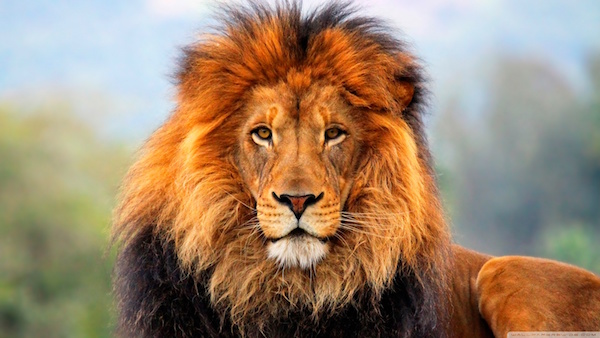
LION
The lion (Panthera leo) is a species in the family Felidae and a member of the genus Panthera. It has a muscular, deep-chested body, short, rounded head, round ears, and a hairy tuft at the end of its tail. It is sexually dimorphic; adult male lions have a prominent mane. With a typical head-to-body length of 184–208 cm (72–82 in) they are larger than females at 160–184 cm (63–72 in). It is a social species, forming groups called prides. A lion pride consists of a few adult males, related females and cubs. Groups of female lions usually hunt together, preying mostly on large ungulates. The lion is an apex and keystone predator; although some lions scavenge when opportunities occur and have been known to hunt humans, the species typically does not.
Typically, the lion inhabits grasslands and savannas, but is absent in dense forests. It is usually more diurnal than other big cats, but when persecuted it adapts to being active at night and at twilight. During the Neolithic period, the lion ranged from Central Asia, Southeast Europe to Africa, but today it has been reduced to fragmented populations in sub-Saharan Africa and one critically endangered population in western India. It has been listed as Vulnerable on the IUCN Red List since 1996 because populations in African countries have declined by about 43% since the early 1990s. Lion populations are untenable outside designated protected areas. Although the cause of the decline is not fully understood, habitat loss and conflicts with humans are the greatest causes for concern.
One of the most widely recognised animal symbols in human culture, the lion has been extensively depicted in sculptures and paintings, on national flags, and in contemporary films and literature. Lions have been kept in menageries since the time of the Roman Empire and have been a key species sought for exhibition in zoological gardens across the world since the late 18th century. Cultural depictions of lions were prominent in Ancient Egypt, and depictions have occurred in virtually all ancient and medieval cultures in the lion's former and current ranges.
The lion is a muscular, deep-chested cat with a short, rounded head, a reduced neck and round ears. Its fur varies in colour from light buff to silvery grey, yellowish red and dark brown. The colours of the underparts are generally lighter. A new-born lion has dark spots, which fade as the cub reaches adulthood, although faint spots often may still be seen on the legs and underparts. The lion is the only member of the cat family that displays obvious sexual dimorphism. Males have broader heads and a prominent mane that grows downwards and backwards covering most of the head, neck, shoulders, and chest. The mane is typically brownish and tinged with yellow, rust and black hairs.
The tail of all lions ends in a dark, hairy tuft that in some lions conceals an approximately 5 mm (0.20 in)-long, hard "spine" or "spur" that is formed from the final, fused sections of tail bone. The functions of the spur are unknown. The tuft is absent at birth and develops at around 5 1⁄2 months of age. It is readily identifiable by the age of seven months.
Of the living felid species, the lion is rivaled only by the tiger in length, weight, and height at the shoulder.Its skull is very similar to that of the tiger, although the frontal region is usually more depressed and flattened, and has a slightly shorter postorbital region and broader nasal openings than those of the tiger. Due to the amount of skull variation in the two species, usually only the structure of the lower jaw can be used as a reliable indicator of species.
The size and weight of adult lions varies across global range and habitats.Accounts of a few individuals that were larger than average exist from Africa and India.
WHERE WILL YOU FIND THEM
You will find the lions at pen E22, right next to the amphitheatre.