
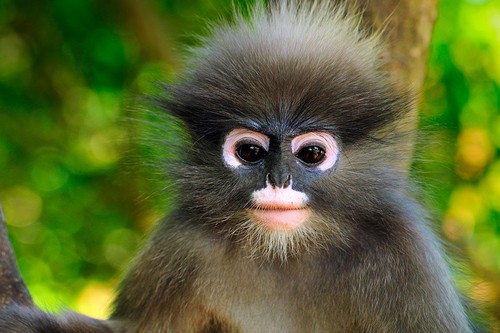
MONKEYS
Monkey is a common name that may refer to groups or species of mammals, in part, the simians of infraorder Simiiformes. The term is applied descriptively to groups of primates, such as families of New World monkeys and Old World monkeys. Many monkey species are tree-dwelling (arboreal), although there are species that live primarily on the ground, such as baboons. Most species are mainly active during the day (diurnal). Monkeys are generally considered to be intelligent, especially the Old World monkeys of Catarrhini.
Simians and tarsiers emerged within haplorrhines some 60 million years ago. New World monkeys and catarrhine monkeys emerged within the simians some 35 million years ago. Old World monkeys and Hominoidea emerged within the catarrhine monkeys some 25 million years ago. Extinct basal simians such as Aegyptopithecus or Parapithecus [35-32 million years ago], eosimiidea and sometimes even the Catarrhini group are also considered monkeys by primatologists.
Lemurs, lorises, and galagos are not monkeys; instead they are strepsirrhine primates. Like monkeys, tarsiers are haplorhine primates; however, they are also not monkeys.
Apes emerged within "monkeys" as sister of the Cercopithecidae in the Catarrhini, so cladistically they are monkeys as well. There has been resistance to directly designate apes (and thus humans) as monkeys, so "Old World monkey" may be taken to mean the Cercopithecoidea or the Catarrhini.That apes are monkeys was already realized by Georges-Louis Leclerc, Comte de Buffon in the 18th century.
Monkeys, including apes, can be distinguished from other primates by having only two pectoral nipples, a pendulous penis, and a lack of sensory whiskers.
As apes have emerged in the monkey group as sister of the old world monkeys, characteristics that describe monkeys are generally shared by apes as well. Williams et al outlined evolutionary features, including in stem groupings, contrasted against the other primates such as the tarsiers and the lemuriformes.
Monkeys range in size from the pygmy marmoset, which can be as small as 117 millimetres (4.6 in) with a 172-millimetre (6.8 in) tail and just over 100 grams (3.5 oz) in weight,to the male mandrill, almost 1 metre (3.3 ft) long and weighing up to 36 kilograms (79 lb).Some are arboreal (living in trees) while others live on the savanna; diets differ among the various species but may contain any of the following: fruit, leaves, seeds, nuts, flowers, eggs and small animals (including insects and spiders).
Some characteristics are shared among the groups; most New World monkeys have prehensile tails while Old World monkeys have non-prehensile tails or no visible tail at all. Old World monkeys have trichromatic color vision like that of humans, while New World monkeys may be trichromatic, dichromatic, or—as in the owl monkeys and greater galagos—monochromatic. Although both the New and Old World monkeys, like the apes, have forward-facing eyes, the faces of Old World and New World monkeys look very different, though again, each group shares some features such as the types of noses, cheeks and rumps
WHERE WILL YOU FIND THEM
You will find the monkeys at pen E22, right next to the amphitheatre.